
 |  |  |
|---|---|---|
 |  |  |
 |  |  |
 |  |  |
 |  |  |
SYDNEY, AUSTRALIA
2024-2025
KILLARA HOME EXTENSION - HERITAGE CONSERVATION AREA
-
Dwelling | Extension
-
Design 2024-2025
-
Site Area 1263.46 m2
-
GFA 318.15 m2
A Dialogue Between Past and Present: Heritage-Inspired Transformation in Killara
For WWAA, architecture is not merely a question of aesthetics or style—it is a process of listening to people, to place, and to history.
Situated within one of Sydney’s Heritage Conservation Areas, this elegant Federation-era home immediately resonated with our team. Purchased for its understated dignity by the owner, Henry, and lovingly curated by his wife, Teresa, the house exuded both charm and character. However, its spatial flow and circulation no longer met the needs of contemporary family life. To WWAA, it resembled a fine piece of uncut marble—its full potential waiting to be revealed, not rewritten.
Our first step was to engage a respected heritage consultant for a detailed site assessment. Although the property was not heritage-listed, its architectural elements—gable rooflines, verandah, chimneys, and mature front garden—were deemed to hold high contributory significance to this heritage conservation area. The design challenge, then, was to reconcile heritage value with the demands of modern living.
Rather than viewing these heritage elements as limitations, WWAA approached them as opportunities. From the outset, we brought together a multidisciplinary team—landscape architect, interior designer, and structural engineer—for on-site collaboration. This integrated process ensured both design coherence and project efficiency from concept through to construction.
The resulting design adopts a low-profile yet confident approach:
-
The original archway was extended to enhance the home’s axial symmetry, creating a spatial rhythm that continues through a series of repeated arches.
-
A gallery space at the end of the corridor was introduced to showcase the owners’ art collection.
-
A central courtyard was inserted into the heart of the home, serving simultaneously as a light well, a ventilation core, and an architectural focal point — lifting the overall atmosphere and connecting interior zones.
-
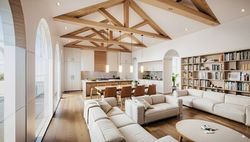
A contemporary open-plan kitchen and dining area was positioned behind the courtyard, establishing a thoughtful transition between the home’s historic front and newly expanded rear.
-
The rear swimming pool was precisely positioned within setback limits and aligned with the living spaces, serving as both a recreational feature and a visual anchor. Framed by the collonaded archway, it reinforces the seamless connection between indoors and out — even in colder months, it remains a tranquil focal point within the landscape.
What moved us most throughout this project was the clients’ unwavering trust. As Teresa often said, “You hold yourself to a high standard, and I trust your design instincts—whatever you recommend, I’ll go with.” This deep trust enabled us to support her and Henry across all aspects of the project—from comparing quotes and negotiating pricing to fine-tuning the budget — ensuring every dollar was invested wisely and purposefully.
This Killara project is more than a renovation—it is the result of a rare and deeply rewarding collaboration: a discerning homeowner and a tightly aligned professional team working in harmony to create something truly timeless and meaningful. It demonstrates what can be achieved when architectural heritage is not frozen in time but reimagined with sensitivity, clarity, and respect.